Principles of Feng Shui
There are many important aspects of Feng Shui you need to be aware of. Below are the most important, as they for the foundation of Feng Shui practices…
Feng Shui is a very refined discipline that has many offshoot techniques intended to concentrate on one aspect of the art or by adding tools or techniques from other schools of Feng Shui thought. At its base though, there are foundations and building blocks that have been a part of Feng Shui practices for hundreds of. There are a few that must be mentioned because they form the foundation of present Feng Shui practices.
Chi
For all of Feng Shui’s practical guidelines and principles there is a theory regarding nature–a metaphysical concept–that forms one of the main pillars of the practice. Following this theory, nature is considered to be a living organism itself, though not one of higher perception. It remains quite and discreet. Nature, in a sense, breathes a life force or spiritual energy that is known as chi. Though this idea is generally agreed upon by the majority of Feng Shui practitioners, the particular details of exactly what nature is, what exactly chi is and the extent to which it operates remain up for debate.
Though it is clear that chi is not a physical force, it can be very hard for some to grasp and this may lead to the impression that this force is only figurative. Rather than being something that we talk about as it actually existed, but is, in fact, a pure fiction, it is asserted that chi is dynamic and a very real presence.
Without this understanding of chi, there is no central principle by which Feng Shui can even operate. When one uses Feng Shui they do so under the impression that the various guidelines, concepts, and principles they employ affect the very flow of this living spiritual source and help attune our homes and businesses to the natural and beneficial course of nature.
The Two Forms of Energy
The types of energies that are associated with Feng Shui teachings are generally described in terms of visibility or invisibility and relate to their location in the natural world.
Visible Energy
When talking about visible energy, we are speaking of the type of chi energy that flows through landforms and exterior architectural features that are, in fact, visible structures on the landscape. Using the landform classification type of Feng Shui, it is possible to determine which type of energy—positive, neutral, or destructive—is present and moving through particular landscapes or architectural design. The principles of Feng Shui treat the exteriors of buildings as landforms.
Invisible Energy
Now, when talking about invisible energy, we are speaking of chi energy that is found inside of building structures. This type of energy is not as readily discernable as visible energy is, so one must employ tools of Feng Shui like the lo-p’an (or compass) and the pa-k’ua (trigrams) in order to chart the levels. Buildings are more complicated than the naturally occurring landscapes and require the use of both branches of Feng Shui (Landform Classification and Building Characteristics) in order to adequately cover both interior and exterior environments and understand the building’s status.
Yin and Yang
If we want to understand Feng Shui better and use it today, it is very crucial to remember the mindset of those who originally conceived it. Though it has been stated in various ways with different points of emphasis applied, one needs to remember that Feng Shui was and is considered a type of ancient Chinese science by practitioners. Approaching Feng Shui from a purely logical Western point of view will obscure the practice. Instead, we should seek to understand the Chinese views of the universe and of heaven and earth.
Here we will encounter yin and yang. These two terms represent what the Chinese believe to be the basic cosmic forces that govern reality. These forces are simultaneously opposing one another and still complimentary. They literally shape the universe and all that is within it. Together Yin and Yang constitute a balanced whole that is called the Tao, meaning “The Way.” In turn, this Tao or Tai Ji as it is called by some, comes from a place called the Great Void known as the Wu Ji, a place between worlds, a nether region. Here resides creation and the realm of absolute wisdom and life. With the term Wu Ji comes a sense of completeness, an all-encompassing vision, symbolized by a circle.
Within the Wu Ji, existence arises and is represented by the dots on any common yin and yang emblem. These dots also symbolize the Tao. The Tao is the abundance that manifests the very substance and matter of the universe, and also produces these dual forces called Yin and Yang.
In the emblem, yin and yang are depicted with the use of opposing colors black and white, which reflects the dualism of night and day, positive and negative, active and passive, hard and soft, fast and slow, male and female, hot and cold, anger and happiness, etc.
With this background, we now turn to Feng Shui and how the application of yin and yang produces balance and harmony and results in good fortune as well as a host of other benefits. By determining the quantities of yin and yang energies that are present, you can find out what needs to be corrected in order to regain balance and have effective Feng Shui.
In the context of Feng-shui it should also be noted that Taoist elements of yin and yang are used in the classification of the natural features of the world. Thus, water is yin while mountains are yang. Earth is yin while the sky is yang. When two of the opposing features come into contact, positive and healthy energy is manifested.
Five Elements
Closely associated with the Chinese and Taoist beliefs in yin and yang is the concept that everything in the world is in a state of constant change or fluctuation among the five elements or forces of natures. They call this wu-xing, or “the five types of chi dominating at different times”.
-
-
- Wood
- Fire
- Earth
- Metal
- Water
-
The term “elements” actually falls short as a description because the five do not signify literal elements, but qualities, constantly overcoming each other in a continuous cycle. It can be a creative and productive relationship: wood fuels fire, fire burns to ash or earth; earth give mineral or metal; when heated, metal flows like water; and water nourishes wood. Or as a destructive and/or negative relationship: wood takes nutrients from the earth; earth pollutes or absorbs water; water kills fire; fire melts metal and metal chops wood.
Through Feng Shui, three definite cycles have been identified that are based on how the five elements happen to be working together in one’s home, office, or other living space.
-
-
- The Enhancing Cycle or the Productive or Generating Cycle. It is the most desirable cycle simply because the elements are in synch and producing positive energy and abundance in life circumstances. It is no guarantee against difficulties but it supplies the energy to handle them when they come.
- The Controlling Cycle is also known as the Destructive or Conquering Cycle. During these points, you have the opposite of the Enhancing Cycle. No harmony, only chaotic confusion.
- The Weakening Cycle or the Exhaustive Cycle. It is considered the most crucial cycle because it deals with the elimination or destruction of negative energy in the elements. Most of the time, this cycle is avoided by everyone but experienced Feng Shui masters due to the serious consequences of improper use, like the loss of goals or benefits. They use it to remove negativity from a particular environment.
-
To achieve the extent of harmony you desire as well as create “good” Feng Shui, you will need to understand the delicate balance and relationships that exist between the elements and direct your efforts to ensure the productivity of these relationships. Remember that each of the elements is also associated with certain direction–the fifth, representing Earth, occupying the center. Each element also possesses corresponding shapes and colors in the natural world.
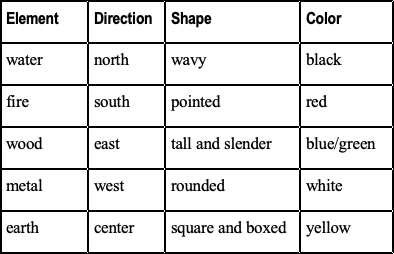
All of these components come together to shape Feng Shui and create balance and harmony.
Pa-k’ua
The pa-k’ua, also called the post-celestial pa-k’ua, was a system of pictographs called trigrams that existed before much of the Chinese writing even appeared. Each shape, or trigram, was a distinct arrangement of three solid and broken lines. Pa-k’ua was used to explain the nature of changes in the universe. It was refined by emperor Wen Wang nearly three thousand years ago in the Zhou Dynasty. Though it was used in Chinese divination, it found wider usage in Feng Shui practices.
Each trigram is made up of solid and broken lines. The solid lines are meant to symbolize yang while the broken lines symbolized yin. Depending upon the number of one type of line versus another in a trigram, you would say whether it was primarily yin or yang. Thus, a trigram with two or more broken lines is primarily yin, while a trigram with two or more solid lines is primarily yang. Yin-type trigrams correspond to receptive energy and stillness and yang-type trigrams correspond to expansive energy and action.
One of the primary assumptions found in Chinese divination is that if one knows how things will change over time then it can be possible to predict future events as well. This is why the trigrams and their patterns of change form the foundation of the I-Ching, or Book of Changes.
The patterns of changes represented in the post-celestial pa-k’ua allows the Feng Shui practitioner to know about the type of energy, destructive or nourishing, that “enters” a particular position of a building (north, south, east, west, etc.) at a specific time. Each direction on the pa-k’ua octagon is thought to have certain significant attributes, many times dependant on one’s date of birth. By charting the pa-k’ua on a home, village, burial ground, etc., information about correct orientation and placement can be gleaned.
The following chart shows the different symbols which make up the pa-k’ua.
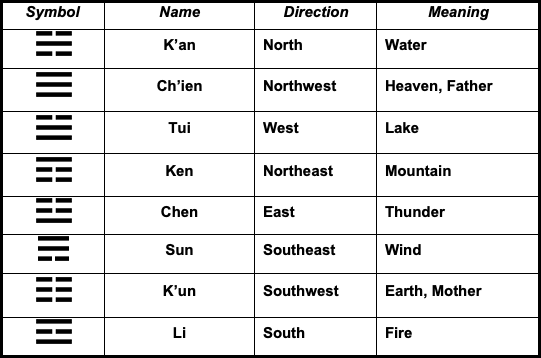
The eight trigrams of the pa-k’ua correspond to the eight stations of life: prosperity, relationships, helpful people, new knowledge, family, children, fame and career.
Geomantic Compass
The geomantic compass is called the lo-p’an, a term created from two words – lo meaning everything and p’an meaning bowl. Together, it means “a bowl that holds the keys to the very mysteries of the universe, or everything.” The geomantic compass used by those who practice traditional Feng Shui is made with bands of concentric rings specially arranged around a magnetic needle.
On a lo-p’an, the “pre-celestial” or “earlier heaven” ring is the one closest to the center on the compass and you will find trigrams of the pa-k’ua imprinted around this ring. Another ring, called the “twenty-four directions” ring, located third from the center, is used to identify what side of the site is the facing direction. It too has markings like the pre-celestial ring, but these symbols correspond to the eight standard compass directions and subdivided into three segments each—hence the twenty-four directions. Most practitioners of traditional Chinese Feng Shui use this kind of twenty-four point compass rather than a common eight-point compass.
Get Your Copy of Jon’s Mastering The Art of Feng Shui, Available on Amazon